
Wine cellar cooling
The cooling unit is the heart of an active wine cellar, but it only works as well as the space around it has been prepared. That is why we choose the unit according to volume, insulation, heat gains and where the heat can go – not just by a figure in a catalogue.

Selection
Cooling unit selection calculator
Indicative recommendation based on the manufacturer’s specifications (maximum volume and installation type) – this is not a heat load calculation. AVS will verify the final selection based on heat gains and the construction.
01
Four questions before you choose
- How is the space insulated? Walls, ceiling, door and, depending on the building, the floor. Insulation determines how much heat the cooling unit has to remove – we design the build-up for the specific space.
- What is its volume, and how much glass is there? Glazing, adjacent heated rooms, lighting and frequent door opening all add heat that the unit has to remove.
- Where can the warm air go? Into an adjacent ventilated room, ducted outside, or to an outdoor unit. This answer most often decides the type of cooling unit.
- Where may the compressor be heard, and how will the condensate and electrics be routed? Noise, drainage and a dedicated circuit breaker need to be resolved before the racking.
02
Maximum volume is not your cellar’s capacity
For every cooling unit, the manufacturer states a maximum volume – for example “up to 25 m³”. But this applies only to a space insulated according to the table in the manual. For a 25 m³ cellar with the Wine IN25 X, that means at least 110 mm EPS, 80 mm XPS or 60 mm PUR on all surfaces, including the floor and door. With weaker insulation or extensive glazing, the same cellar needs a more powerful unit.
Capacity also falls as the temperature of the space receiving the heat rises. At 35 °C in that space (40 °C for some split units), the unit may no longer be able to hold 12 °C in the cellar. That is why it matters where the heat goes – and also that the manufacturer makes the warranty conditional on insulation according to its table. More detail in our guide How to insulate a climate-controlled wine cellar.
03
Wine Master cooling unit types
| Type | Where the unit sits | Where the heat goes | Models | When it suits |
|---|---|---|---|---|
| Through-wall | in the wall between the cellar and an adjacent space | into an adjacent ventilated room or outside | C25 X (25 m³), C50 (50 m³) | simple installation; the adjacent space can take warm air |
| In the cellar, ducted | in the cellar on brackets | outside via two insulated ducts | IN25 X (25 m³), IN50 X (50 m³) | no outdoor unit; only grilles on the façade |
| Outdoor, ducted | outdoors | directly outside | OUT25 X (25 m³) | no equipment or noise wanted in the cellar |
| Split | indoor unit on the wall, in the ceiling or behind a wall; compressor outdoors | via the outdoor unit | SP40 CA, SP40 CE, SP40 DU (40 m³), SP80 DU (80 m³), SP100 (100 m³) | larger and glazed cellars, a quiet interior |
| Display cabinet | in the cabinet ceiling | into the space above the cabinet | ARM15 X (15 m³) | climate-controlled display cabinets and wine cupboards |
Volumes are the manufacturer’s maximum values with insulation according to the manual. An overview of all models with specifications is in the Cooling units category.
04
Humidity: what a cooling unit can and cannot do
Wine Master cooling units cool, hold the set temperature (factory setting 12 °C, range 8–18 °C), and some versions can also heat. During cooling, water vapour condenses on the evaporator, so the air is partly dehumidified. The units do not, however, have separate humidity control.
Stable humidity comes mainly from a well-insulated, airtight space that heat and moisture from the surroundings cannot penetrate. If the air in the cellar is persistently dry, the manufacturer offers the Hygromaster humidifier; for overly humid spaces, the Drymaster dehumidifier. We describe the values wine needs on our Wine storage page.
05
Noise, condensate, electrics and servicing
- Noise is stated by the manufacturer in dB at distances of 1 m and 3 m. With split and outdoor units the compressor is outside the cellar; with through-wall and ducted units it can be heard in the cellar.
- Condensate runs through a hose into a drain or a container; in the ARM15 X display cabinet unit it evaporates within the unit. The drain must be accessible for inspection.
- Electrics: a dedicated circuit breaker; for many models the manufacturer requires at least 16 A. Remote monitoring (Winemaster Connect) requires a data connection.
- Servicing: change the dust filter at least once a year, and inspect and clean the condensate hose at least once a year. The cooling unit must remain accessible.
- PRO split units are supplied without refrigerant; connecting and charging the circuit is carried out by a certified refrigeration technician.
06
Cooling unit installation and servicing
We supply, install and connect the cooling unit on site, anywhere in the Czech Republic. Before handover, we test it under real operating conditions.
- 01Installation and connectionfitting the unit and connecting the cooling system on site, coordinated with the finishing works
- 02Commissioningtesting under real operating conditions, handover with training and documentation
- 03Servicing and maintenanceservicing of wine cellar cooling units throughout the Czech Republic, seasonal inspections by arrangement
What regular maintenance involves
- replacing the dust filter as needed, at least once a year
- inspecting and cleaning the condensate drain at least once a year
- cleaning the outdoor unit and its surroundings
The intervals are based on Wine Master’s manuals. The manuals are available in the Catalogues and manuals section.
07
Sources
Technical data are based on the manufacturer’s current documentation: winemaster.fr and Wine Master manuals (IN25 X, version 07/2025, SP40 CA PRO, version 07/2025, SP40 DU PRO, version 14/2025). All manuals are available in the Documents section. The values are the manufacturer’s minimum requirements and do not replace a design for a specific building.
Technology
Section through an active cellar.
Stable conditions come from the combination of insulation, cooling capacity and airflow between the racks.
- 01The room’s insulated envelope
- 02Cooling sized to the volume
- 03Air circulation
- 04Racking system
- 05Glazing with steel frames
- 06Condensate drain
08 / Wine Master
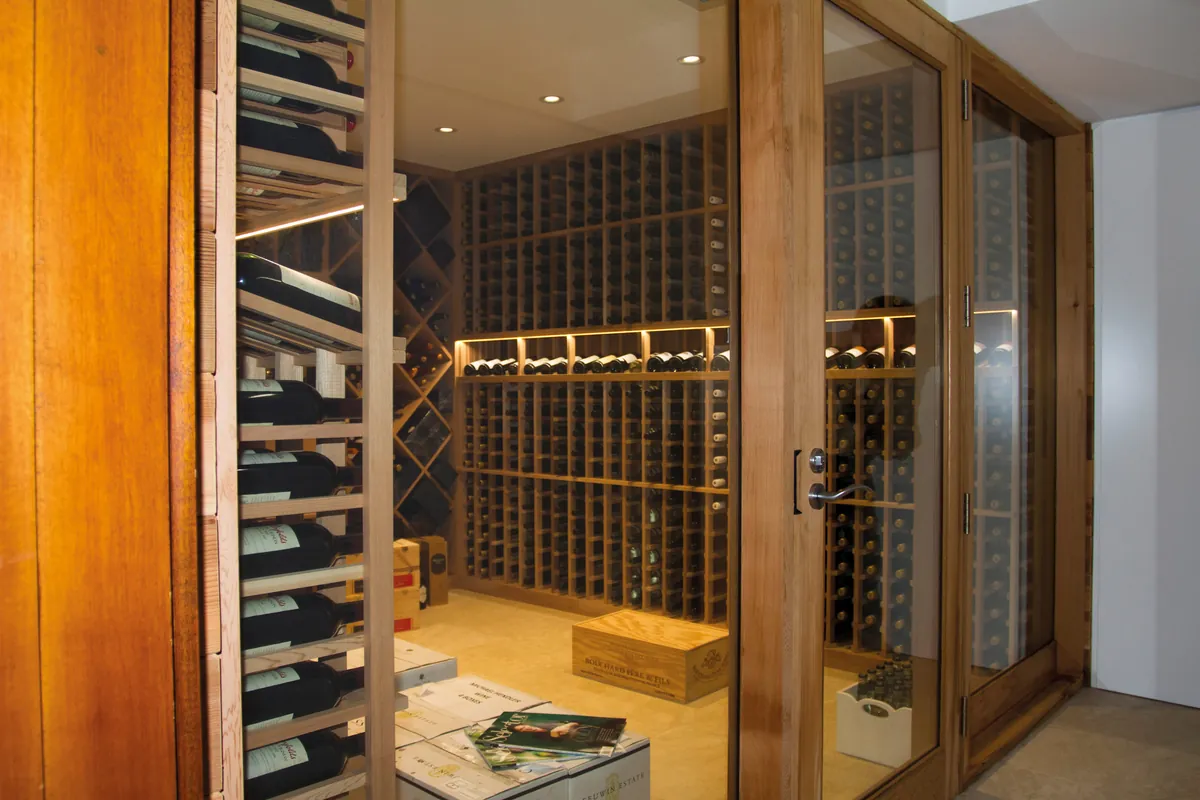
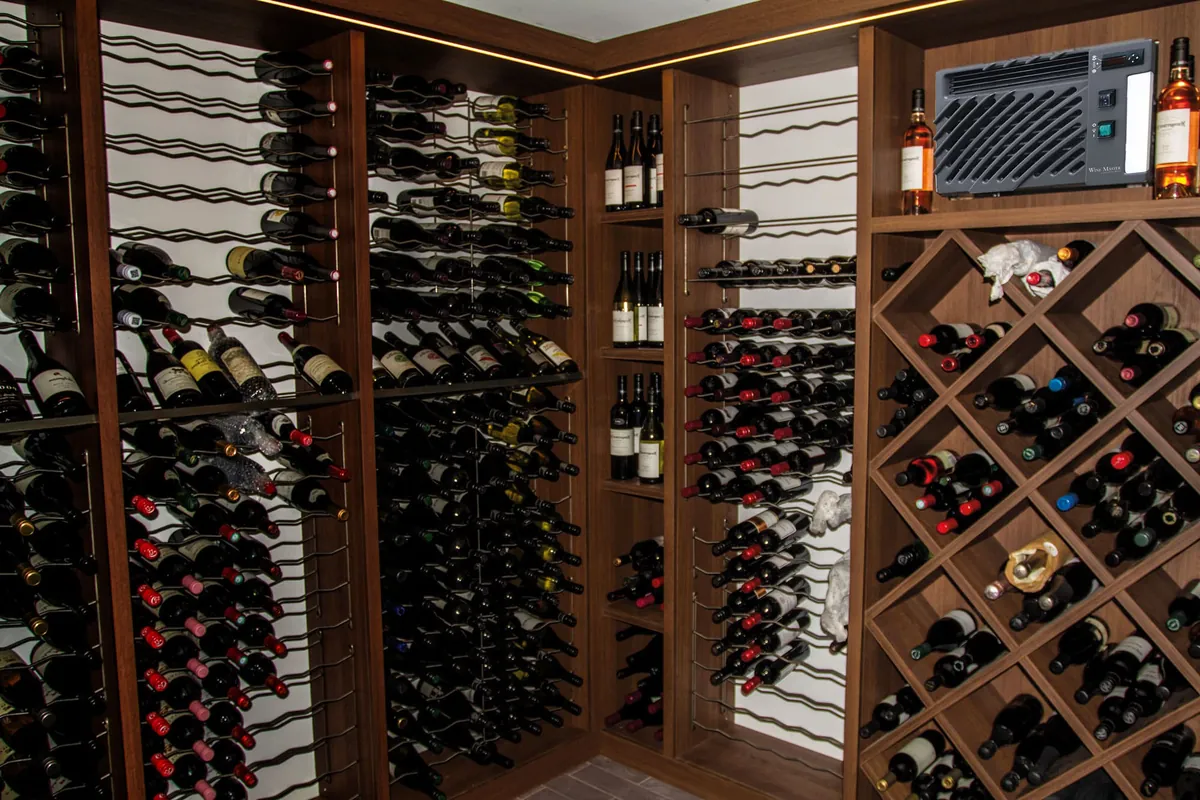
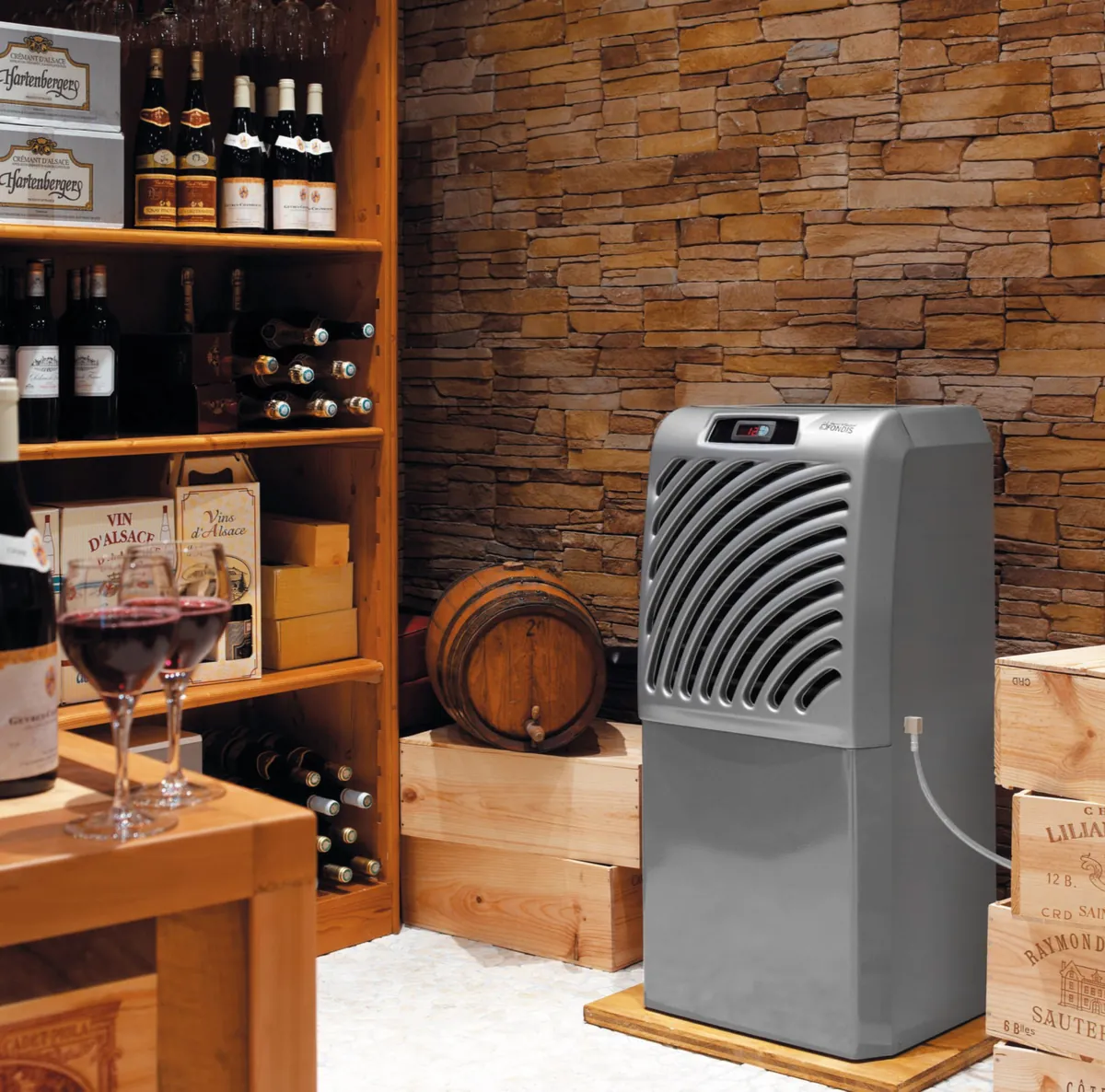
Wine Master cooling unit installations
Photographs: Wine Master.
09 / Related
Continue
10 / Questions
Frequently asked questions
Is an ordinary domestic air conditioner enough for a wine cellar?
Ordinary air conditioners are not designed for continuous operation at around 12 °C and dry the air more. Wine cellar cooling units operate in the 8–18 °C range, have evaporator defrosting and are built for continuous operation.
What cooling unit do I need for a 20 m³ cellar?
With insulation to the manufacturer’s specification, a unit rated up to 25 m³ (C25 X, IN25 X or OUT25 X) is usually sufficient – the type depends on where the heat can be dissipated. With extensive glazing, weaker insulation or warm surroundings, we choose a larger class. We recommend a specific unit after assessing the space.
Will the cooling unit also maintain the right humidity?
It does not control humidity on its own. Stable humidity comes mainly from the insulation and airtightness of the space; for humidifying or dehumidifying, the manufacturer offers the separate Hygromaster and Drymaster devices.
How often does the cooling unit need servicing?
The manufacturer recommends replacing the dust filter as needed, at least once a year, and inspecting and cleaning the condensate drain just as often. With split units, the outdoor unit should also be kept clean.
Should I buy the unit myself or the whole cellar through you?
Either is possible. We can supply the unit alone, but for a complete cellar it pays to resolve the cooling together with insulation, glazing and heat dissipation – otherwise you risk undersized capacity or unnecessary noise.
Enquiry
Send us a photograph of your space.
A short description, dimensions or a floor plan is enough for an initial assessment. We usually reply within one working day.